The History of Hillcrest — You Are Sleeping on a Legend
You are not just staying at a vacation rental. You are sleeping in the original farmhouse of one of the most remarkable men in the history of the upper Ohio Valley — on land that was once the most famous cattle farm in America.
You Are Staying on a Legend
When guests arrive at Hillcrest Retreat they often ask about the farmhouse. They can feel that it is old. They can feel that something happened here. The stone foundation. The hand cut timber beams. The way the building sits in the landscape as if it grew there rather than was built.
They are right to feel it.
The farmhouse at Hillcrest Retreat dates to the 1890s. It sits on what was once the most famous cattle farm in America — Hillcrest Farms — the domain of one of the most extraordinary men the upper Ohio Valley ever produced.
His name was Charles A. Smith. And without him there would be no Chester, West Virginia.
The Man Who Built Chester
Charles A. Smith — known to everyone simply as C.A. Smith — was born April 14, 1867, in Wellsville, Ohio, the youngest of eight children. He was not born to wealth or privilege. He started his working life as a water boy on a gas pipeline crew at seventeen years old. The other workers kidded him mercilessly.
One day the young Smith had enough. He told them off in the plain spoken language he would become famous for throughout the Ohio Valley. He told them that someday they would be working for him — because he would own the line.
Within a few years that is exactly what happened. Two of those same men worked for him for years.
That was C.A. Smith. A man who set a goal and worked without stopping until he achieved it. Every time.
He expanded his interests constantly — oil and gas operations in Pennsylvania, West Virginia, and Ohio. He acquired the Ohio Valley Gas Company and sold it in 1898. He arrived in the Chester area attracted by the development potential he saw on the West Virginia side of the Ohio River.
In 1899 C.A. Smith began the development of what is now Chester, West Virginia.
He became — as the local history recorded — the leading figure in the development of the new town after 1899, having seen the potential needs of the community very quickly.
Many residents of Chester still claim that Smith named the town itself after his uncle Chester Mahon. Whether true or not the claim speaks to how completely Smith shaped this place and how deeply the local memory holds him.
What C.A. Smith Built
The scope of what one man built in one lifetime in one small Ohio River town is genuinely extraordinary.
Smith owned and operated the traction lines — the electric streetcar system — connecting Beaver Pennsylvania to Steubenville Ohio. He owned interests in two potteries. He developed Rock Springs Park. He built the Chester Sewer Company. He constructed the entire water supply system for Chester — piping water from the Hillcrest Farm area to serve the growing town — and operated it for nearly half a century before selling it to the City of Chester in 1946 for $253,000.
He owned and operated the Chester Bridge — the vital Ohio River crossing on the Lincoln Highway — from 1901 until 1938 when he sold it to the State of Ohio for $2,185,000. In 1935 he made Ripley's Believe It Or Not when the bridge was rebuilt without stopping traffic. During his ownership the bridge handled thousands of automobiles per day as a vital link on US Route 30.
He was responsible for paving old Route 2 from Chester to New Cumberland — the road that today runs past Hillcrest Retreat.
He owned the light and power rights in the Steubenville and East Liverpool area and sold them to what became the Ohio Power Company in 1917.
He operated the Valley Motor Transit Company — the bus line that replaced the streetcars — until his death.
He was connected with the American Vitrified Products Company. He developed the South Side Land Company. He promoted Chester lots and homes with the kind of energy and vision that made him — as friends remembered in tribute after his death — one of the few remaining self-made men whose business acumen and vision at the turn of the century helped so much in the development of the upper Ohio Valley.
He drove the first automobile in Chester. A Stanley Steamer. He reportedly drove it across the Ohio River when the water was low on a wager — succeeding on his second attempt. He traveled fast everywhere he went. When a state trooper stopped him on the road to New Cumberland he told the officer to write two citations — because he would be coming back just as fast.
That was C.A. Smith.
He died October 13, 1953 at his home on Pyramus Street in Chester. He was 86 years old.
As the local history records — Mr. Smith did more in his lifetime to bring fame to Chester than all the other developers of the city combined.
Hillcrest Farms — Known the World Over
For the last ten years of his life C.A. Smith's greatest passion was Hillcrest Farms.
The farm took form in 1917 on land along what is now Route 8 — the same land where Hillcrest Retreat stands today. In 1918 Smith went into the Hereford cattle business and began producing championship stock. What followed was one of the most remarkable chapters in American agricultural history.
The herd at Hillcrest Farms at one time numbered seven hundred head of Hereford cattle.
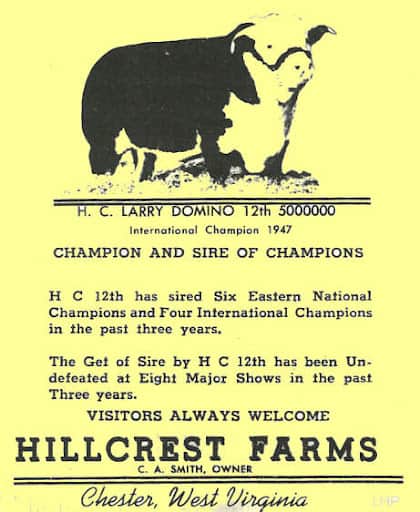
From Hillcrest Farms came the grand champion bull of the Chicago International Livestock Exposition in 1947, 1949, and 1951. The grand champion finale at Chicago in 1950 and 1951. Grand champions at Baltimore and Kansas City and livestock shows across America. Smith had the best ten head at Chicago in 1948, 1949, 1950 and 1951 — four consecutive years of dominance at the most prestigious livestock show in the country.
The sale records were equally staggering. In 1950 Smith sold one of his prize bulls to Henry Sears of Chestertown Maryland for $70,500 — a record price at the time. In January 1951 a world record was set when a half interest in his main breeding bull — HC Larry Domino 12th — was sold for $105,000 to E.C. McCormick Jr. of Akron.
C.A. Smith served as president of the Hereford Association of America. His sale of Herefords set world records both for a single sale and for the total amount. The local history says simply — his Hillcrest Farms were known the world over and brought thousands of people to the area.
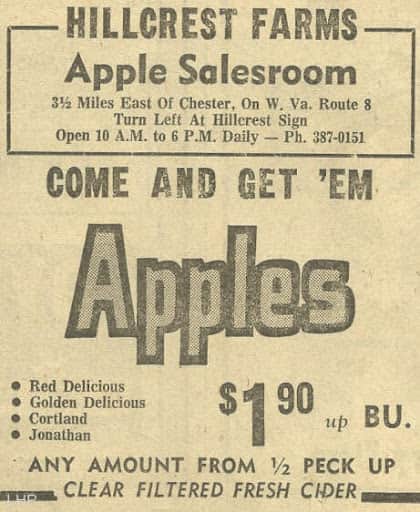
In addition to the cattle Smith had one thousand acres set aside for apple growing at Hillcrest. The famous Hillcrest Apple Orchards supplied the region for generations. He also operated a large peach orchard in the Tinsonville area shipping peaches throughout the east.
The land that is now Hillcrest Retreat — the fields, the hillsides, the tree lines — was once part of this extraordinary operation. Prize bulls worth more than most houses walked this ground. International visitors came to Chester specifically to see Hillcrest Farms. The farmhouse that Brian and Charlene live in today stood at the center of it all.
The Farmhouse — Still Standing Since the 1890s
The farmhouse at Hillcrest Retreat dates to the 1890s — built during the era when this land was being developed as what would become one of the most famous agricultural estates in America.
The stone foundation running the full base of the building is original. Hand laid by craftsmen in the nineteenth century. That stonework will outlast everything built in the last fifty years within a hundred miles of here.
The original pub room with its carved mahogany bar is original to the farmhouse era. A room where people gathered — farm workers, business associates, family — for over 130 years. The pot belly stove. The brick fireplace. The exposed timber ceiling beams cut from the surrounding hills.
The screened porch bar. The wide covered porch looking out over the property toward the West Virginia hills. The property's relationship to Route 8 — the road C.A. Smith himself was responsible for paving — all of it is original.
When you sit at the carved bar in the Hillcrest pub and pour a glass of Brian's real ale you are sitting in the same room where the men and women who made Chester what it is gathered to end their working days.
That is not a marketing claim. That is simply history.
The Legacy Continues
Brian and Charlene Mahaffey did not know all of this history when they came to Hillcrest Retreat. They were drawn by the property itself — the land, the farmhouse, the pub, the fields — the way people are drawn to places that have a weight and presence that newer properties simply do not have.
Learning the history of C.A. Smith and Hillcrest Farms gave a name and a story to what they had already felt.
They are the latest chapter in a property that has been part of the story of Chester West Virginia since the 1890s. They brew real ale in the pub where generations before them gathered. They maintain the fields where prize Herefords once grazed. They welcome guests into a farmhouse that has sheltered people through more than a century of Ohio Valley history.
The Hillcrest WMA — the 2,212 acres of protected wilderness adjacent to the property — was carved in part from land that was once part of the broader Hillcrest agricultural legacy. The landscape guests explore when they walk into the wilderness from Hillcrest Retreat is the same landscape that made this corner of West Virginia famous across the country in the first half of the twentieth century.
A Note From Brian
When I learned about C.A. Smith and what this land was I felt the weight of it differently than I had before. This is not just a property. It is a piece of history that has somehow survived — the farmhouse still standing, the fields still open, the pub room still gathering people after long days.
Charlene and I try to be worthy of that history. The welcome we give guests. The care we put into maintaining the property. The ale I brew in the original pub room.
C.A. Smith built Chester with determination and vision and more energy than any ten ordinary men. The least we can do is take equally good care of what he left behind.
When you stay at Hillcrest Retreat you are sleeping on a legend.
We hope it feels that way.
— Brian
A Timeline of Hillcrest History
1867 — Charles A. Smith born in Wellsville Ohio
1890s — The Hillcrest farmhouse is built on the property along what would become Route 8
1899 — C.A. Smith begins development of Chester West Virginia
1900 — Smith pipes water from the Hillcrest Farm area to supply Chester
1901 — Smith purchases the Chester Bridge — the vital Ohio River crossing
1914 — Smith takes full ownership of the Chester Bridge
1917 — Hillcrest Farms takes formal shape as C.A. Smith's primary agricultural interest
1918 — Smith begins Hereford cattle operations at Hillcrest. The herd will eventually number 700 head.
1935 — Smith makes Ripley's Believe It Or Not when the Chester Bridge is rebuilt without stopping traffic
1938 — Smith sells the Chester Bridge to the State of Ohio for $2,185,000
1947 — A Hillcrest bull wins grand champion at the Chicago International Livestock Exposition. The farm will win again in 1949 and 1951.
1950 — Smith sells a prize Hillcrest bull for $70,500 — a world record at the time
1951 — A half interest in HC Larry Domino 12th — the main Hillcrest breeding bull — sells for $105,000. A new world record.
1953 — C.A. Smith dies at his home in Chester at age 86
1917 to present — The Hillcrest farmhouse stands
Today — Brian and Charlene Mahaffey welcome guests to Hillcrest Retreat — the original Hillcrest Farms property — where the 1890s farmhouse still stands, the pub still pours, and the fields that once held the most famous Hereford herd in America now offer wilderness, privacy, and the kind of genuine West Virginia hospitality that C.A. Smith himself would have recognized.
Stay in the History
[Book The Hillcrest Manor Cottage — From $175 Per Night] [Reserve The Skyview Cabin — From $395 Per Night] [Experience The Historic Pub — Add-On $50 Per Person] [Contact Brian — [email protected]]
HillcrestRetreat.com [email protected]
Hillcrest Retreat · 199 Hillcrest Manor Drive · Chester, West Virginia 26034 The original Hillcrest Farms property — established 1890s Hosted by Brian and Charlene Mahaffey 4.99 Stars · Airbnb Superhost · Over 100 Five Star Reviews
Sources and Further Reading
The history of C.A. Smith drawn from A History of Chester — Gateway to the West by Roy C. Cashdollar and from the Lou Holtz Upper Ohio Valley Hall of Fame where C.A. Smith is an honoree.
The Lou Holtz Upper Ohio Valley Hall of Fame is located in East Liverpool Ohio — 15 minutes from Hillcrest Retreat — and is well worth a visit for anyone interested in the remarkable history of the upper Ohio Valley.